
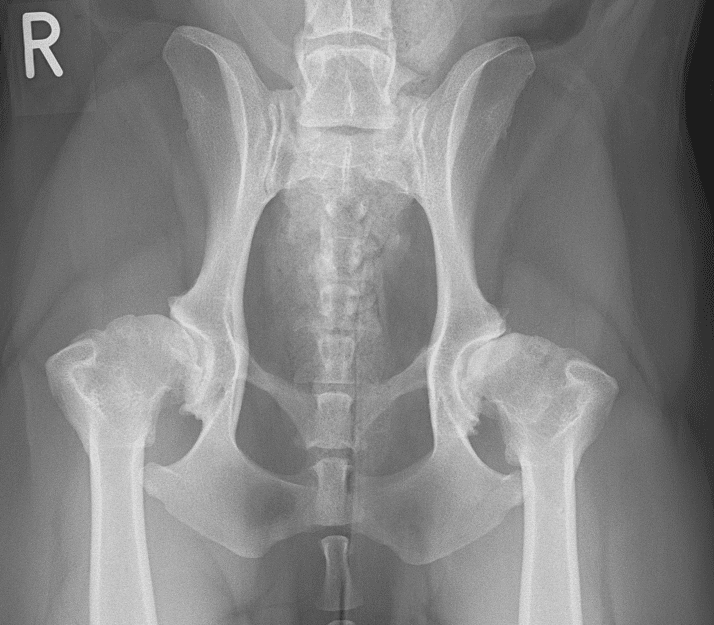
My young dog has been diagnosed with dysplasia. What does this mean for their future?
A diagnosis of hip or elbow dysplasia in a young dog can feel like a blow, especially when your dog is otherwise full of energy and may not be showing any obvious signs of pain. It is natural to wonder what this means for their future, and whether there is anything you can do now to help.
What is dysplasia?
Dysplasia means abnormal development of a joint. In hip dysplasia, the ball and socket of the hip joint do not fit together as snugly as they should. The elbow is a complicated joint, and three bones fit together in order to permit normal movement. In elbow dysplasia, one or more parts of the elbow joint develop abnormally. In both cases, the result is a joint that does not move as smoothly as a normally formed joint, and that is placed under uneven stresses during everyday movement.
The link to osteoarthritis
Dysplasia itself is a structural issue, but its long-term significance lies in what it leads to. Hip dysplasia can progressively trigger the development of osteoarthritis, characterised by cartilage damage, bone remodelling with the formation of osteophytes, and inflammation within the joint (Olsson, 1971).
This means that even a young dog with dysplasia and minimal signs of discomfort today may be at risk of developing arthritis at an early age. The abnormal joint mechanics caused by dysplasia place extra wear on the cartilage and surrounding tissues over time, gradually setting the stage for the joint changes we associate with arthritis.
Arthritis is more common in young dogs than many people realise
It is easy to think of arthritis as an old dog’s problem, but recent research suggests otherwise. A 2024 study (Enomoto et al.) examined 123 dogs aged between 8 months and 4 years and found that nearly 40% had radiographic signs of osteoarthritis in at least one joint, with around 20% of dogs suffering clinical signs such as joint pain. The most commonly affected joints, in order, were the elbow, hip, tarsus (hock), and stifle (knee).
Perhaps the most striking finding was how often this went unrecognised. Among the dogs identified with clinical osteoarthritis in that study, only two were receiving any form of pain management at the time, and the authors concluded that pain from osteoarthritis appears to be both underdiagnosed and undertreated in young dogs.
This matters because the joints most affected by dysplasia, the hip and the elbow, are also among the joints where early arthritis is most commonly found. A young dog with dysplasia is therefore exactly the kind of patient in whom early joint changes can be quietly developing, often before an owner has noticed anything obviously wrong.
Why early signs matter
In young dogs with joint laxity and pain, signs might include occasional ‘bunny hopping’ with the hind limbs, sitting to one side or another consistently, reluctance to jump, limping on a front leg after a walk, or being stiff after rest. Some young dogs with dysplasia will go on to develop significant arthritis relatively early in life, while others remain comfortable for many years with appropriate management. Behaviour can also be a marker of pain in young dogs, so pets who seem to dislike being handled or are unusually anxious may have underlying painful joint changes. If any of these signs occur for more than a week to 10 days, it is important to discuss the benefits of further diagnosis with your vet.
What can be done?
Management of dysplasia and early arthritis usually involves a multi-modal approach with several elements working together rather than a single fix. (Marcellin-Little et al. 2025) These can include:
Weight management, highly important since extra body weight increases the load on already compromised joints, and fat tissue itself can promote further inflammation
Controlled exercise, balancing enough activity to maintain muscle support around the joint without overloading it
Pain relief and anti-inflammatory medication, used appropriately and reviewed regularly can be safe even in young animals, and management of pain is important to avoid secondary behavioural changes such as defensiveness.
Joint supplements, where there is reasonable evidence of benefit – your vet can advise on these
Physiotherapy or hydrotherapy, to maintain muscle strength and joint mobility
Some surgical options exist in more severe cases
Physiotherapy and hydrotherapy
Physiotherapy and hydrotherapy are increasingly recognised as valuable components of multimodal management for both hip and elbow dysplasia, at all stages of the disease. A physiotherapy ‘pyramid’ encompassing environmental modifications, exercise plan, home exercises, and professional physiotherapy treatment has been proposed (Mille et al., 2022)
Hydrotherapy is particularly well suited to dysplastic joints. Because water buoyancy significantly reduces the load placed through the joint during movement, dogs can exercise safely and build supportive musculature without placing the kind of stress on compromised cartilage that land-based exercise can involve. A clinical study in Labrador Retrievers (Preston and Willis, 2018) found that even a single hydrotherapy session produced a measurable increase in thoracic limb range of motion and stride length, in both normal and dysplastic affected dogs, suggesting this may be a useful to maintain range of motion. A controlled randomised clinical study in dogs with hip dysplasia found that hydrotherapy and laser photobiomodulation produced improvements in pain scores, joint motion, and muscle mass maintenance over time (de Oliveira Reusing et al., 2021).
That said, the evidence base for physiotherapy in canine dysplasia and osteoarthritis remains smaller than for some other treatment modalities, and the optimal frequency and duration of treatment is not yet established. For this reason it is best understood as an important part of a coordinated management plan rather than a standalone solution, and ideally guided by a veterinary physiotherapist who can tailor the programme to your dog’s individual needs.
Intra-articular treatments: another option in the toolkit
For some dogs, particularly where joint inflammation is a significant part of the picture, treatments injected directly into the joint (intra-articular treatments) can play a role. These aim to reduce inflammation and improve comfort directly at the site of the problem.
There is a currently a small body of research looking at intra-articular treatments for dogs with hip dysplasia and associated arthritis. One placebo-controlled study comparing intra-articular hyaluronic acid to traditional conservative treatment in dogs with osteoarthritis associated with hip dysplasia found that both approaches reduced clinical signs, though more significant improvements were seen with the hyaluronic acid injection (Carapeba et al., 2016).
Platelet-rich plasma (PRP)
Platelet-rich plasma is prepared from a sample of the dog’s own blood, concentrating the platelets that contain growth factors thought to help modulate inflammation and support tissue repair. Placebo controlled studies (e.g Alves et al., 2021) in dogs with hip osteoarthritis, found a significant reduction in pain and lameness in dogs treated with intra-articular PRP compared with those given a placebo injection.
While these results are encouraging, a recent review (Cardona-Ramírez et al., 2025) of the wider evidence concluded that the overall body of research on PRP remains limited, and that larger trials are still needed to establish how effective it is. PRP is therefore best thought of as a promising option that may help some dogs, rather than a guaranteed solution, and its suitability is something to weigh up case by case.
Arthramid (polyacrylamide hydrogel)
Arthramid Vet is a 2.5% polyacrylamide hydrogel that is injected into the joint, where it integrates into the joint lining rather than being absorbed and cleared like some other injectable treatments. Owner-reported outcome data found that the majority of dogs treated with this hydrogel were rated as somewhat or much better afterwards, and notably, among dogs that had been receiving pain medication, a substantial proportion were able to reduce or stop those medications following treatment. Adverse effects were uncommon and generally mild, most often transient soreness at the injection site (Barnhard et al., 2025).
These owner-reported findings are promising, but it is important to note that they are based on owners’ impressions rather than formal clinical measurements, and the study authors themselves highlight that controlled studies are needed to confirm how well the treatment works. As with PRP, it is a treatment that may benefit certain dogs and is worth discussing in the context of an individual dog’s situation.
These treatments are not a cure for dysplasia itself, and they are not right for every dog. Whether an intra-articular treatment is appropriate depends on factors such as the dog’s age, the severity of joint changes, and the overall management plan. Intra-articular injection of anti-inflammatory and joint-protective substances is increasingly recognised as a practical option in the management of osteoarthritis in dogs, used as part of a wider plan rather than in isolation.
Other joints that can be affected in young dogs
Hip and elbow are the joints most commonly associated with dysplasia in young dogs, but they are not the only joints that can be affected by abnormal development. A related group of conditions, collectively known as osteochondrosis, can affect other joints in growing dogs and lead to similar long-term consequences.
In osteochondrosis, the normal process by which cartilage converts to bone during growth is disrupted. In some cases this progresses to a stage called osteochondritis dissecans (OCD), where a flap of abnormal cartilage separates from the underlying bone and causes pain, joint inflammation, and lameness. These conditions are most commonly seen in large and giant breeds, typically presenting between six and eighteen months of age, and they carry a risk of secondary osteoarthritis if left unmanaged.
The shoulder is the most frequently affected joint for osteochondrosis in dogs. It typically causes thoracic limb lameness that may come on gradually and can be easy to attribute initially to a soft tissue injury or general exercise-related stiffness. Where a cartilage flap has formed, surgical removal is usually recommended, and the prognosis following surgery is generally good.
The tarsus (hock) can also be affected, with lesions typically occurring on the medial ridge of the talus. Tarsal OCD tends to carry a more guarded long-term outlook than shoulder OCD, particularly if degenerative joint changes are already present at the time of diagnosis.
The stifle (knee) is less commonly involved but can develop osteochondral lesions on the femoral condyles. Signs may be subtler than in shoulder OCD, which can make diagnosis less straightforward.
If your young dog has been diagnosed with any form of developmental joint disease, or if you have a large-breed puppy showing any unexplained lameness, it is worth discussing with your veterinary surgeon whether a full orthopaedic assessment is appropriate. Early identification of any joint affected by abnormal development gives the best opportunity to manage it proactively, before secondary arthritis becomes established.
The takeaway
A dysplasia diagnosis in a young dog is not a single event but the start of an ongoing conversation about how best to support that dog’s joints over their lifetime. The earlier this conversation starts, the more options are usually available, and the better placed you are to make informed choices as your dog’s needs change over time.
If your dog has been diagnosed with dysplasia and you would like to discuss what this might mean for them specifically, including whether intra-articular treatments could have a role in their management plan, do get in touch. Online consultations are available nationally, alongside in-person appointments across Somerset and Devon.
References
Alves JC, Santos A, Jorge P. Platelet-rich plasma therapy in dogs with bilateral hip osteoarthritis. BMC Vet Res. 2021 Jun 5;17(1):207. doi: 10.1186/s12917-021-02913-x. PMID: 34090433; PMCID: PMC8180029.
Barnhard JA, Tringali AA, Caldwell NC, Webb KR, Levine D, Markley AP, Shoben A, Green MM, Brunke MW. Owner-reported outcomes indicate intra-articular 2.5% polyacrylamide hydrogel injection is well tolerated and reduces osteoarthritis signs in dogs. J Am Vet Med Assoc. 2025 Sep 24;264(3):1-6. doi: 10.2460/javma.25.06.0398. PMID: 40997901.
Carapeba GO, Cavaleti P, Nicácio GM, Brinholi RB, Giuffrida R, Cassu RN. Intra-Articular Hyaluronic Acid Compared to Traditional Conservative Treatment in Dogs with Osteoarthritis Associated with Hip Dysplasia. Evid Based Complement Alternat Med. 2016;2016:2076921. doi: 10.1155/2016/2076921. Epub 2016 Oct 26. PMID: 27847523; PMCID: PMC5101385.
Cardona-Ramírez S, Wolfe PN, Correa-Valencia NM. Intra-articular use of platelet-rich plasma and its derivatives in canine osteoarthritis: a systematic review. J Am Vet Med Assoc. 2025 Sep 5;263(11):1434-1443. doi: 10.2460/javma.25.01.0033. PMID: 40912277.
de Oliveira Reusing, M.S. et al. (2021) Effects of hydrotherapy and low-level laser therapy in canine hip dysplasia: a randomized, prospective, blinded clinical study. Revue Vétérinaire Clinique, 56(4):177–184.
Enomoto, M. et al. Prevalence of radiographic appendicular osteoarthritis and associated clinical signs in young dogs. Sci. Rep. 14, 2827 (2024). doi: 10.1038/s41598-024-52324-9
Marcellin-Little DJ, Hulse DA, Huntingford JL, Grubb T, Brunke MW, Markley AP and Frank B (2025) A proposed framework for practical multimodal management of osteoarthritis in growing dogs. Front. Vet. Sci. 12:1565922. doi: 10.3389/fvets.2025.1565922
Mille, F. et al. (2022) Physiotherapeutic strategies and their current evidence for canine osteoarthritis. Veterinary Sciences, 10. Available via PMC: https://pmc.ncbi.nlm.nih.gov/articles/PMC9863568
OLSSON, S.-E. (1971), Degenerative joint disease (osteoarthrosis): A review with special reference to the dog. Journal of Small Animal Practice, 12: 333-342. https://doi.org/10.1111/j.1748-5827.1971.tb06238.x
Preston, T. and Wills, A.P. (2018) A single hydrotherapy session increases range of motion and stride length in Labrador Retrievers diagnosed with elbow dysplasia. The Veterinary Journal, 234:105–110.
