
Our services
At Pet Pain Relief, we specialise in comprehensive pain assessment for dogs and cats. By carefully reviewing your pet’s medical history and thoroughly evaluating their lifestyle and behaviour, we build a detailed understanding of the types and impacts of pain your pet may be experiencing. This allows us to create a tailored treatment plan that addresses their specific needs.
Chronic pain often develops gradually over months or even years, and its effects can be complex and varied. While your vet is skilled in managing most common pain problems, some cases require more time and specialist expertise—especially when pain is severe or not improving as expected. Our longer consultations ensure every aspect is considered, and we always provide a detailed report to keep your vet, physiotherapist, and other professionals fully informed about your pet’s care.
How we help dogs and cats with pain problems

In-person consultations allow for a detailed, pain-focused evaluation of the patient. We review their medical history, previous investigations, and carefully evaluate their lifestyle and behaviour, before performing a structured physical and pain examination. This thorough approach helps us identify the type and impact of your pet’s pain, and allows us to recommend the most appropriate treatments or adjustments to their current plan.
Following assessment, a written report is provided to the referring veterinary surgeon outlining findings, differential considerations and management recommendations.
In-person assessment is particularly appropriate where physical examination and aseessment are required to clarify pain sources.
Online consultations offer a convenient way to explore further treatment options for your pet. Online consultations are available as an advisory service for suitable cases.
These involve:
- Review of the medical history and available diagnostic information from your vet, behaviourist, and other professionals
- Assessment of submitted videos and questionnaires
- Discussion of current management and response to treatment
A written advisory report is provided to the primary veterinary surgeon. Online consultations do not replace physical examination and do not involve prescribing; responsibility for clinical decision-making remains with the referring practice. Book your appointment

Physical therapies — such as acupuncture and therapeutic laser — can address different points along the pain pathway, often working best when combined with medication in a multimodal approach.

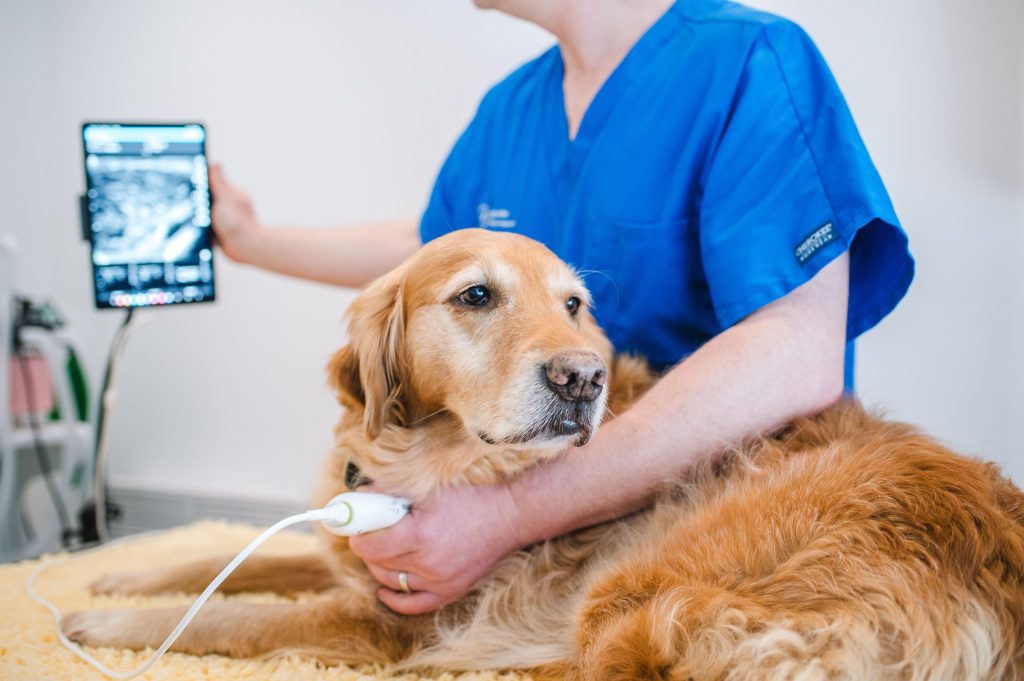
Ultrasound makes use of high frequency sound waves to offer a non-invasive method for examining soft tissues such as muscles and tendons. In many cases, pets can have an ultrasound while awake; however, sedation may be advised to allow a thorough assessment of deeper structures. We use careful patient monitoring throughout any sedation to ensure your pet’s safety. If your own vet refers your pet for an outpatient ultrasound , we will share a detailed report with them so they can continue to oversee your pet’s care.
Delivering medication directly around peripheral nerves can help control pain in a specific part of the body. In some cases, targeted interventional techniques may be discussed. These procedures are considered where conventional medical management has been insufficient and where there is a clear clinical rationale. Decisions are made collaboratively, with clear discussion of potential benefits, limitations and risks.
Low back pain related to nerve compression or inflammation can respond to epidural steroid injections performed under a short anaesthetic. Interventional treatments may be considered as part of a treatment approach where consevative management alone is insufficient to manage pain. Potential risks, uncertainties and alternative options are discussed as part of the consent process.

Intra-articular treatments may be considered in selected cases where joint-related pain has been identified as a significant contributor to clinical signs, and where appropriate medical management has not provided sufficient relief.
These interventions may be appropriate following a thorough pain-focused assessment and review of relevant imaging and clinical history. Potential risks, uncertainties and alternative options are discussed as part of the consent process.
Intra-articular options may include the administration of substances intended to support joint function or modulate pain and inflammation. Such treatments are considered as part of a wider, multimodal pain management plan rather than as standalone solutions.
Pricing
| Initial Consultation | Repeat Consultation | Online Consultation | MSK Ultrasound | Acupuncture only |
| £395 all inclusive | £215 | £225 | Registered £325 Outpatient £410 | £70 |
| Pre-appointment review (1 hour) of medical history and results of imaging/ investigation (£45) | Pre-appointment review of medical notes and response to treatment (£15) | Pre-appointment review (1 hour) of medical history/imaging and response to treatment (£45) | Non-invasive imaging of one area to assess soft tissue structures, including muscle and tendon | Where your primary vet has diagnosed a condition and acupuncture is appropriate, we can administer this at their request. |
| Pre-appointment clinical metrology instruments to evaluate pain | Pre-appointment clinical metrology instruments to evaluate pain | Pre-appointment clinical metrology instruments to evaluate pain | Registered patients may undergo ultrasound and (if appropriate) treatment with PRP/ corticosteroid during the same appointment | – |
| In-person 60 minute consultation and assessment, including acupuncture or laser (£250) | In-person 30 minute consultation, including acupuncture or laser (£150) | Online 60 minute consultation including your vet and physio if desired (they may charge for this additionally) (£130) | Outpatient examinations include report provided to the referring veterinary practice and/or physiotherapists | Your primary vet retains responsibility for prescribing medications, and monitoring response to treatments. |
| Comprehensive report with medication, adjunctive, and lifestyle recommendations provided to you and your vet (£100) | Summary report with any recommended changes provided to you and your vet (£50) | Summary report with any recommended changes provided to you and your vet (£50) | Sedation/ anaesthesia at additional cost if required | Treatment notes are provided to your primary vet for them to continue managing your pet’s case |
| Free written prescription if required (normal cost £12) | Free written prescription if required (normal cost £12) | – | Ultrasound of additional areas during same session £100 | – |
| Email support for 4 weeks | Email support for 4 weeks | Email support for 4 weeks | – | Email support charged £25 per enquiry |
| Complementary online follow up (10 minutes) | – | – | – | – |
Platelet-Rich Plasma Joint/Tendon Injection from £600
Written Prescription £12
Additional Procedures – contact us to enquire
Case studies

Case Study P
P had a 12 month history of chronic right forelimb lameness. She had undergone CT scans which showed changes in her left elbow and sacroiliac joints. Evaluation demonstrated marked myofascial pain of right trapezius and left hypaxial muscles. Alteration of her medication and monthly acupuncture treatment led to dramatic improvements in her mobility, interaction with her owner, and quality of life.

Case Study K
K had a longstanding issue of guarding items in the household, gastrointestinal problems, and exhibiting anxious behaviour, which had continued despite behavioural referrals, and an underlying pain was suspected. Painkillers had been prescribed but the source of pain was unknown. He exhibited a wide based stance with a shortened stride in his hindlimbs and significant pain in his hypaxial muscles, which could have been related to a protective stance due to abdominal pain. Additional medications to assist his stomach, painkillers to address muscle pain, and some management changes all contributed to a vast improvement in his behaviour.